Embarking on Adventures with Sound and Story
ALL CATEGORIESLESSON PLANSTEACHING/LEARNING MATERIALSSCIENCES
5/21/20265 min read


The Importance of Imaginative Play
Imaginative play is vital for childhood development. It encourages creativity and allows children to explore their thoughts and emotions in a safe environment. Through stories and sound, children can create their own adventures, providing them with a sense of freedom to express themselves.
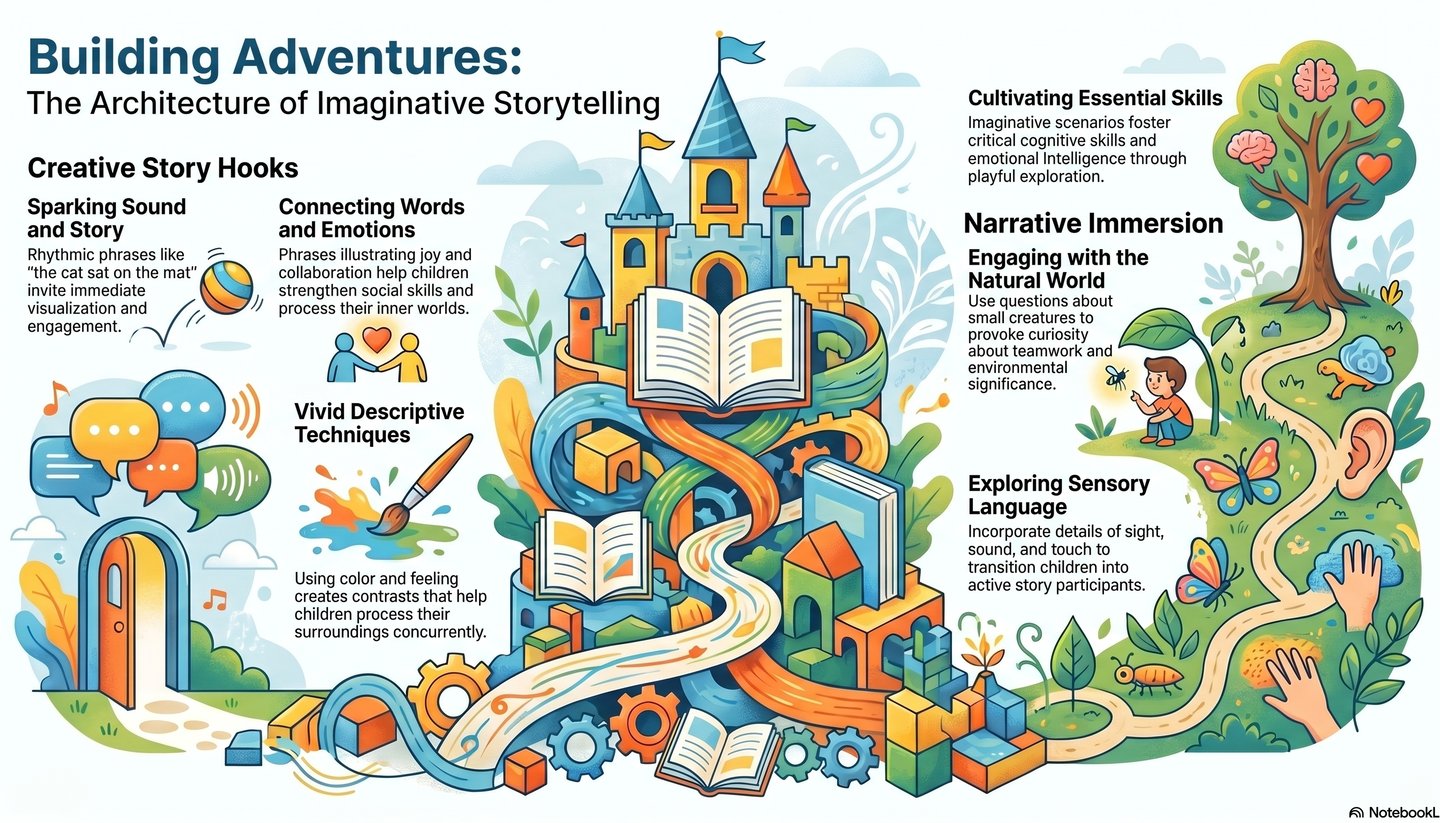
Sparking Sound and Story
When we introduce sentences that spark sound and story, we open the door to a universe of adventures. For example, consider the phrase, "the cat sat at the mat with a hat." This simple sentence not only captures attention but also invites children to visualize and engage with the story. Such sentences can be used as playful jumping-off points for broader storytelling adventures.
Connecting Words and Emotions
The power of words lies in their ability to evoke emotions. Take the sentence, "I am glad to jam with Sam and Pam." Words like these connect children with meaningful experiences, illustrating joy and collaboration. Encouraging children to think of their own examples can stimulate their creativity further. They might create different adventures where two friends work together, strengthening their social skills.
Utilizing Descriptive Techniques
Utilizing vivid descriptions can enhance the storytelling experience. For instance, in the sentence, "add the red pad to the sad lad’s bag," the images of color and emotion become powerful tools. Colors and feelings can create contrasts and add depth to stories, allowing children to process their surroundings and their inner worlds concurrently.
Exploring Sensory Language
Sensory language plays a crucial role in bringing stories to life. The phrase, "the air was fair near the chair by the stair," invokes imagery that connects children with their sensory experiences. By creating narratives that include details about sight, sound, and touch, we help children transition from listeners and readers into active participants in their adventures.
Engaging with Nature
Nature provides endless inspiration for adventures. Asking simple questions about the universe surrounding children encourages exploration. For example, when asking, "ask the ant to act with the axe on the apple," we provoke curiosity about the small creatures and their environments. This question can lead to stories about teamwork and the significance of even the smallest beings in our lives.
Final Thoughts
Adventures in storytelling not only cultivate imagination among children but also foster critical cognitive skills and emotional intelligence. By incorporating engaging sentences, sensory language, and imaginative scenarios, we can help young minds navigate through the magical world of sound and story. Let's empower children to embark on their own adventures!
Beyond the Page: How Simple Sentences Build Big Imaginations
We often think of a child’s imagination as a wild, untamable thing—a boundless forest or a distant galaxy. Yet, as specialists in developmental psychology, we know that we hold the blueprints for these vast worlds in the very sentences we speak. The architecture of imaginative play is not built from complex manuals, but from a surprisingly simple foundation: the safe, structured environment of narrative exploration. When we provide a child with a story, we aren’t just reading words; we are scaffolding a space where they can explore their internal emotional landscape with total freedom.
Acoustic Scaffolding: The Phonetic Roots of Vision
The journey into a narrative universe frequently begins not with the eye, but with the ear. For the developing brain, rhythmic and phonetic sentences serve as more than mere entertainment—they are forms of acoustic scaffolding that build phonological awareness while capturing the child's undivided attention. Consider the rhythmic cadence of a simple phrase:
"the cat sat at the mat with a hat"
From a clinical perspective, this sentence functions as a "playful jumping-off point" for visualization. The repetitive, predictable sounds create a sense of security, allowing the child to devote their cognitive resources to the creative process of mental imagery. By hearing these sounds, the child begins the transition from mere auditory processing to active visualization, using the phonetic structure as an anchor for their burgeoning imagination.
Affective Resonance: Linking Literacy to Social Intelligence
Narrative construction offers a unique laboratory for synthesizing social scenarios and emotional development. Simple sentences can act as a "cognitive bridge," connecting abstract social concepts with meaningful life experiences. Take, for example, the phrase: "I am glad to jam with Sam and Pam."
This sentence does more than teach rhyme; it illustrates the concepts of joy and collaboration through affective resonance. By reflecting on such narratives, children are encouraged to internalize the mechanics of cooperative play and empathy. When a child imagines friends working together toward a common goal—the "jamming" session—they are strengthening the neural pathways associated with social intelligence and collaborative problem-solving.
Chromic Anchoring: The Psychological Power of Visual Contrast
To help a child navigate both their internal world and their external environment, we must utilize vivid descriptions that provide emotional and visual depth. In developmental psychology, we refer to this as "anchoring." By linking an abstract emotion to a concrete visual, we create a "mental peg" that aids in emotional regulation and memory.
Consider the sentence: "add the red pad to the sad lad’s bag." Here, the contrast between a bright, concrete color (red) and a complex internal state (sad) provides the child with a framework to process feelings. The "red pad" becomes a visual anchor for the "sad lad," helping the child visualize and categorize emotional depth. This technique allows the developing mind to process sensory surroundings and inner affective states concurrently, providing them with the tools to navigate the complexities of human experience.
Sensory Immersion: Transforming Listeners into Active Participants
The transition from a passive listener to an active protagonist in a storytelling adventure relies heavily on sensory language. By incorporating details related to sight, sound, and touch, we facilitate a state of narrative immersion.
A phrase like "the air was fair near the chair by the stair" utilizes sensory imagery to connect the child directly to their own lived experiences. When a story prioritizes these tactile and spatial details, the child no longer merely hears the narrative—they inhabit it. This shift is vital for cognitive development, as it moves the child from the role of an observer to an active participant, empowered to direct the course of their own imaginative adventure.
The Micro-Epic: Literacy, Alliteration, and Perspective
Nature serves as a perpetual catalyst for curiosity, but the true magic happens when we find the epic within the microscopic. Consider the prompt: "ask the ant to act with the axe on the apple."
From a literacy standpoint, the heavy use of alliteration—the repeated "A" sound—functions as a sophisticated tool for phonetic mastery. Simultaneously, the narrative tension inherent in the imagery—an ant wielding an axe against a giant apple—introduces the concept of hyperbole and stakes. This teaches children perspective-taking; it asks them to imagine the significance and labor of even the smallest beings. By provoking curiosity about the "universe surrounding them," we help children understand teamwork and their own place within a vast, interconnected ecosystem.
Conclusion: Empowering the Next Generation of Critical Thinkers
Imaginative storytelling is far more than a childhood pastime; it is the fundamental machinery through which we cultivate the next generation of empathetic leaders and critical thinkers. By utilizing engaging phonetic structures, sensory language, and the wonders of the natural world, we provide young minds with the map they need to navigate the world. These simple sentences are the building blocks for a lifetime of exploration and emotional intelligence.
How will you help a child embark on their own transformative adventure today?